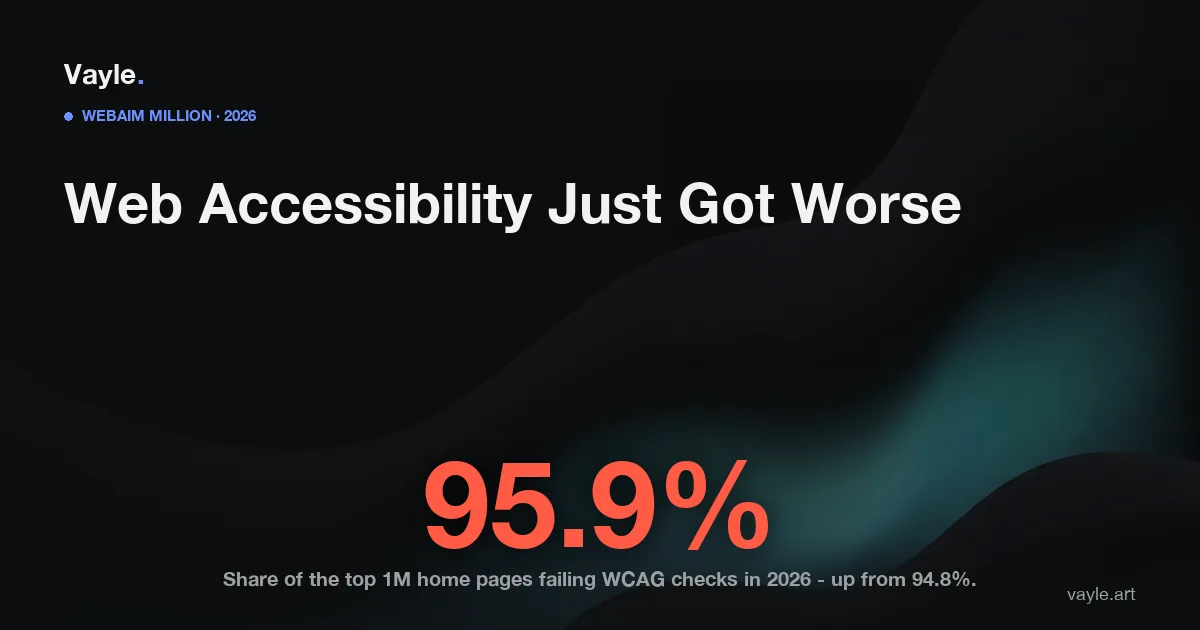
Every year one nonprofit runs the same measurement, and every year it was the closest thing the field had to good news. WebAIM - a nonprofit accessibility center at Utah State University - scans the top 1,000,000 home pages on the web against automated WCAG (Web Content Accessibility Guidelines) checks and publishes the tally. For six years running the numbers crept the right way: a little less broken each time. The 2026 report, released this year, reversed that. The share of home pages with detected failures went up, the average number of errors per page went up, and the tool many teams reach for to improve accessibility turned out to correlate with more errors, not fewer. For an Ontario business staring down a December 2026 compliance deadline, that reversal changes the odds in a specific, uncomfortable way.
Key facts
- 95.9% of the top 1,000,000 home pages had detected WCAG 2 failures in 2026, up from 94.8% in 2025 - the first increase after six straight years of small improvements (WebAIM).
- Home pages averaged 56.1 detected errors each, a 10.1% rise over 2025's 51, across 56,114,377 total errors in the sample (WebAIM).
- The six most common failures were low-contrast text (83.9%), missing image alt text (53.1%), missing form-input labels (51%), empty links (46.3%), empty buttons (30.6%), and missing document language (13.5%) (WebAIM).
- Home pages using ARIA (Accessible Rich Internet Applications) averaged 59.1 errors versus 42 on pages without it - roughly 17 more barriers where ARIA was present (WebAIM).
- Ontario's IASR (Integrated Accessibility Standards Regulation, O. Reg. 191/11) s.14 requires organizations with 50 or more employees to meet WCAG 2.0 Level AA on public websites, and the next ACR (Accessibility Compliance Report) for organizations with 20 or more employees is due December 31, 2026 (ontario.ca).
What did the WebAIM Million 2026 report actually find?
Three things, and none of them flattering. First, coverage of failure got broader: 95.9% of home pages had at least one detectable WCAG error, up from 94.8% the year before. That sounds like a rounding blip until you remember it broke a six-year trend of the number slowly falling - the direction, not just the value, is the story. Second, the pages got more broken on average: 56.1 errors each, a 10.1% jump, adding up to more than 56 million distinct errors across the sample. Third, the failures are boringly consistent. The same six problems dominate every year, and they are all things a customer feels immediately: text they can't read against its background, images that announce nothing, form fields with no label, links and buttons that a screen reader reads as empty, and pages that never declare what language they're in. Four of those six map straight onto guides we've already written - colour contrast, image alt text, form labels, and the accessible names behind links and buttons - because they are the failures that keep showing up on real Ontario sites too.
Why is accessibility getting worse, not better?
The report points at complexity, and one culprit in particular. Home pages are heavier every year - more components, more JavaScript, more third-party widgets - and each added part is another place a barrier can hide. The sharpest finding is about ARIA, the set of HTML attributes meant to make custom components understandable to assistive technology. Pages that used ARIA averaged 59.1 errors; pages that didn't averaged 42. That is not because ARIA is bad - it's because ARIA is easy to apply wrong, and a wrong role or a broken aria-label actively misleads a screen reader instead of helping it. This is the exact point of our earlier piece: bad ARIA is worse than no ARIA. The 2026 numbers are that argument at web scale. The takeaway isn't "avoid ARIA" - it's that bolting on more code, whether hand-written ARIA or a third-party script, doesn't reliably make a site more accessible, and often does the reverse.
What does a regressing web mean for an Ontario business?
It widens the gap you're expected to close. Ontario's AODA (Accessibility for Ontarians with Disabilities Act) names WCAG 2.0 Level AA as the enforceable standard through the IASR, and your ACR is due December 31, 2026 if you have 20 or more employees. The AODA gives no customer a private right to sue - the real provincial route is a disability-discrimination complaint to the HRTO (Human Rights Tribunal of Ontario) under the Ontario Human Rights Code, which has no minimum-employee threshold - and any Ontario business selling into the United States also carries ADA (Americans with Disabilities Act) exposure. The WebAIM data doesn't change any of those rules. What it changes is the base rate: if roughly 96% of the most-resourced sites in the world fail an automated check - the easy half - the odds that your own site is clean without deliberate work are slim, and the December deadline is firm regardless of which direction the web is drifting. Here's the full Ontario compliance picture in one place.
What actually moves your site off that 95.9%?
Not more scripts, and not a scan alone. WebAIM's automated tooling catches the obvious layer - contrast, missing labels, empty controls - but automated checks find only a fraction of the WCAG criteria that actually deny service; keyboard traps and broken screen-reader flows only surface when a human tests, which is the whole difference between a scan and a real audit. The durable work is the same three steps every gap needs: an audit that combines automated and manual testing against WCAG 2.2 AA; source-code remediation that fixes the real HTML and components rather than layering a widget on top (here's why an overlay isn't remediation); and documented remediation - a dated record of what you found and fixed - which is what an honest ACR should reflect by December 31, 2026. The web getting worse is exactly why doing the real work is worth more, not less.
If you want a second pair of eyes on your site, send it to me and I will tell you what I would fix first and what it would cost, the same working day.
Vayle is a remote-first accessibility-engineering studio serving Ontario. General information, not legal advice.