There is a comforting story a lot of business owners have been told: drop one line of JavaScript on your site, a little accessibility button appears in the corner, and you are covered. The 2026 litigation numbers are the clearest evidence yet that the story is wrong. When plaintiffs went looking for inaccessible websites last year, a large share of the sites they sued already had exactly that kind of tool running. The button was there. The lawsuit came anyway. For an Ontario business weighing whether a bolt-on widget is "good enough" for the December 2026 reporting deadline, that gap between what the widget promises and what it delivers is the whole story.
Key facts
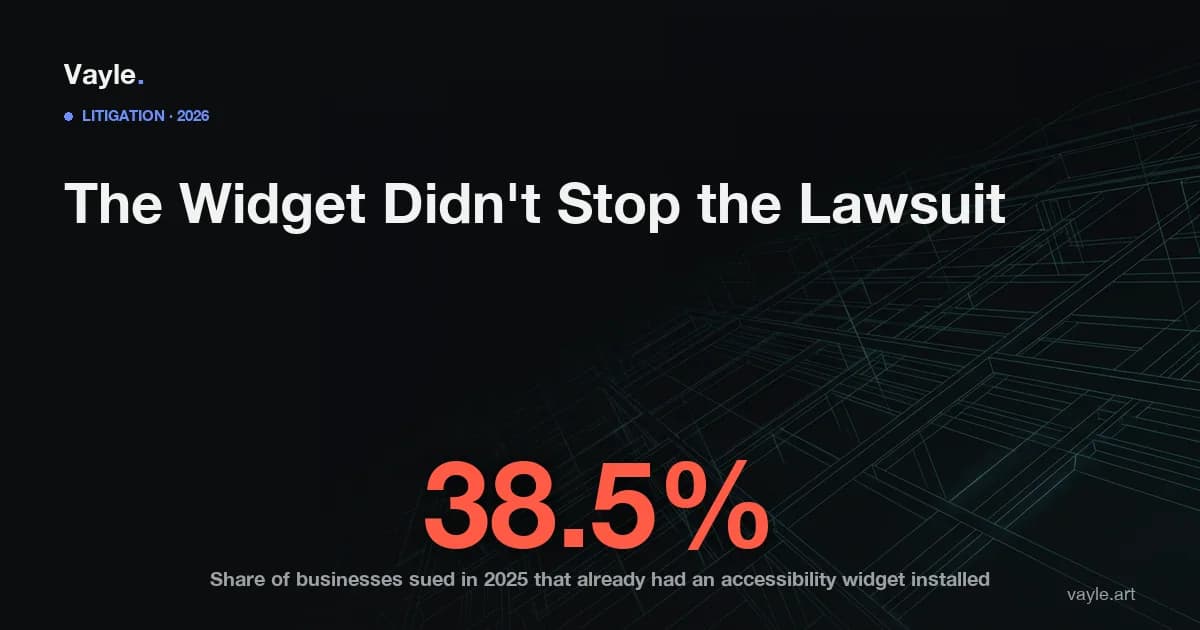
- 38.5% of businesses sued over an inaccessible website in 2025 already had an accessibility solution in place - typically a widget or toolbar - according to AudioEye's 2026 Web Accessibility Litigation Report (AudioEye).
- 26,253 U.S. web accessibility lawsuits were filed in 2025 (5,791 federal, 20,438 state), a 102% increase since 2020; roughly 77% were filed in state courts (AudioEye 2026 report).
- In June 2026 alone, 97 of 363 web accessibility lawsuits - about 27% - targeted sites that were running a third-party accessibility widget (UsableNet lawsuit tracker).
- 78% of 2025 lawsuits targeted e-commerce sites, and 64% cited barriers on interior pages (product pages, checkout, dashboards) rather than the home page alone (AudioEye 2026 report).
- Ontario's AODA (Accessibility for Ontarians with Disabilities Act) has no private right of action - the individual complaint route is the HRTO (Human Rights Tribunal of Ontario) under the Ontario Human Rights Code - and the next ACR (Accessibility Compliance Report) for organizations with 20 or more employees is due December 31, 2026 (ontario.ca).
What did the 2026 litigation data actually find?
The headline number is the one worth sitting with: more than a third of the businesses sued last year were not doing nothing. They had bought a product, seen the accessibility icon appear on their site, and reasonably assumed the problem was handled. It was not. The AudioEye report describes these as "usually widgets or toolbars" that create a false sense of security while the underlying page stays inaccessible to the people the law is meant to protect.
The rest of the data explains why the widget did not help. Two thirds of the lawsuits pointed to barriers on interior pages - the product detail page, the cart, the booking step - not the marketing home page. A script that overlays a settings menu does not rebuild a checkout flow that a screen reader cannot complete or a keyboard cannot navigate. And with lawsuits now overwhelmingly filed in state courts and pro se filings climbing, the volume is not slowing. This is the same picture we walked through in the 2025 lawsuit hotspots and in why AI has lowered the barrier to filing, now confirmed by a fresh year of numbers.
Why doesn't an accessibility widget stop a lawsuit?
Because a widget operates on top of your website, not inside it. It cannot see or change the source code where the actual WCAG (Web Content Accessibility Guidelines) failures live: an image with no alt text, a form field with no label, a colour contrast that falls below the threshold, a modal that traps the keyboard. Those defects are in your HTML and your components. A script layered over them can toggle a high-contrast mode or resize text, but it does not fix the missing label or the broken focus order underneath. This is the distinction we lay out in full in overlay versus real remediation and in what a third-party widget can and cannot do.
There is a second problem, and it is a legal one. The FTC (Federal Trade Commission) has already taken enforcement action against an overlay vendor over deceptive accessibility marketing claims. So the widget did not just fail to prevent the lawsuit - in some cases the promise attached to it was itself the thing regulators objected to. A tool that tells you it makes your site compliant, when the site still fails, is a tool selling exactly the false sense of security the 2026 data measured.
What does this mean for an Ontario business?
The litigation figures above are American, but the exposure is not confined to the United States. Two things follow for an Ontario organization. First, if you sell into the U.S. - and most e-commerce does - you are inside the same ADA (Americans with Disabilities Act) litigation pool those 26,253 lawsuits came from, widget or not. Second, at home the enforceable path runs through the HRTO: a customer denied equal access can file a human-rights complaint, and "we installed a widget" is not an answer to whether the person could actually use your site. Neither route is impressed by an icon in the corner.
There is also the reporting obligation. The IASR (Integrated Accessibility Standards Regulation) requires organizations with 50 or more employees to meet WCAG 2.0 Level AA on public websites, and every organization with 20 or more employees must file an ACR by December 31, 2026. A widget does not produce the honest record of what you assessed and fixed that an ACR is supposed to reflect - which, as we cover in ACR versus VPAT, is the document Ontario actually asks for.
How do you actually reduce the risk?
You reduce it the way the data implies: by fixing the site itself, in the code, and keeping a record of it. Nobody can promise a lawsuit will never arrive - the honest goal is fewer real barriers and a defensible, dated account of the work. That starts with knowing what is actually broken, which a bolt-on button cannot tell you and an automated scan only partly can (here is why a scan is not an audit). From there, documented remediation - a dated log of what you found and what you changed - is the thing that stands up under an HRTO complaint or an ADA claim in a way a widget subscription never has.
If you want a second pair of eyes on your site, send it to me and I will tell you what I would fix first and what it would cost, the same working day.
Vayle is a remote-first accessibility-engineering studio serving Ontario. General information, not legal advice.